Behave the Biology of Humans at Our Best and Worst Review
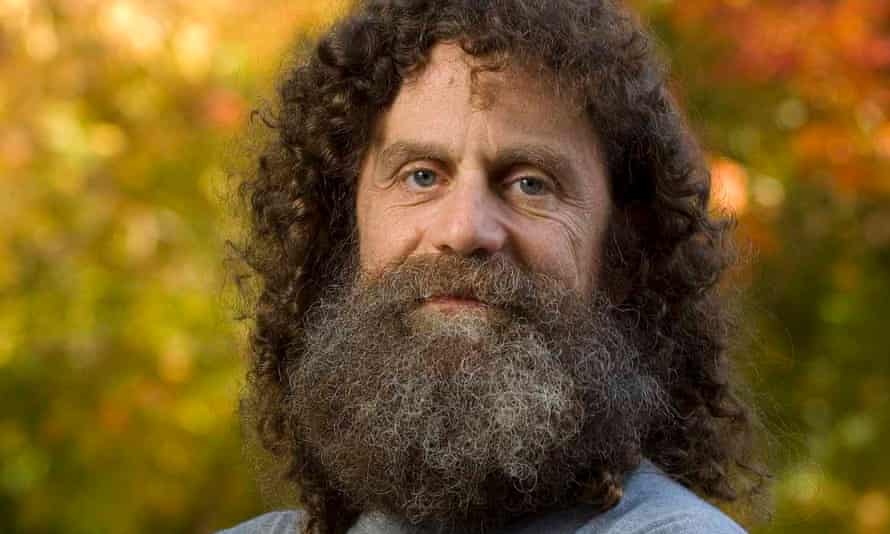
Y ou reach out to bear on someone'due south arm, or perhaps you pull a trigger. What made that happen? In this extraordinary survey of the scientific discipline of human behaviour, the biologist Robert Sapolsky takes the reader on an ballsy journey backwards through time, and through different scientific disciplines. His governing question is: what explains the fact that humans tin massacre one another but too perform spectacular acts of altruistic kindness? Is one side of our nature destined to win out over the other?
The backwards time-travel is an excellent organising principle. Seconds earlier our action, it is neuroscience that investigates what is going on in the brain; minutes to days before is the domain of endocrinology (hormonal fluctuations). Days to months before, we focus on the brain's ability to learn and rewire itself. Sapolsky goes dorsum through boyhood, childhood and gestation (including genetics), and, across the birth of the private, to more than afar causes however – those found in culture, evolutionary psychology, game theory and comparative zoology. He makes the book consistently entertaining, with an infectious excitement at the puzzles he explains, and wry dude-ish asides. (Humans, he notes, can "delay gratification for insanely long times" compared with other animals. "No warthog restricts calories to expect good in a bathing arrange next summertime.") He likes to call sure facts "extraordinary" when he is personally amazed past them; it'south charmingly infectious.
This book is a miraculous synthesis of scholarly domains, and at the same time laudably careful in its conclusion to point out at every step the limits of our knowledge. Sapolsky offers a bright account of a standard view before lining upwards complications or objections to information technology from other research, specially in brain scientific discipline. (Testosterone, for case, does not crusade aggression but amplifies pre-existing tendencies for or against it. The deportment of such molecules in general "depend dramatically on context"). In a phrase that has unfortunately become associated with the quack attempts to smuggle creationism into American schools, he is practiced at "instruction the controversy", often providing anecdotes of scientists with contesting views from decades ago. Throughout, he insists on how much individual variability in that location is subconscious beneath the statistical averages of studies, and how the explanation of nearly every human phenomenon is going to be "multifactorial": dependent on many causes. The literature on one scientific question, he notes comfortingly, is "majorly messy".
Along the fashion there are many counterintuitive ideas and stern lessons. Empathy – feeling someone's pain – is not every bit probable to atomic number 82 to useful action every bit dispassionate sympathy, or "cold-blooded kindness". Income inequality is concretely causally bad for the wellness of the poorer. There is a well-established link between rightwing authoritarianism and lower IQ. Genes are not destiny, and they are not "selfish" a la Dawkins; "we haven't evolved to exist 'selfish' or 'donating' or anything else – we've evolved to be particular ways in particular settings". (According to i amazing survey, 46% of women would salve their ain dog rather than a foreign tourist if both were menaced past a delinquent double-decker. The evolutionary explanation is that they experience more "kinship" with the dog.) In full general, if our worst behaviours are "the product of our biology", and so are our best ones. That Sapolsky'southward eye is evidently in the right place makes it like shooting fish in a barrel to discount sure hippyish outbursts such as that the invention of agriculture "was one of the all-time human blunders", since information technology led to sedentary living and social bureaucracy. Sure, but information technology too led to wine, science and books, which I'd suggest on balance makes it rather a good thing.
More thorny is the point at which he comes to address the question of individual choice and responsibility. For about 600 pages, barring the odd mention of the "cognitive" aspects of human being action, Sapolsky sidelines the question of what place conscious reasoning has in determining behaviour, amidst all the neurochemical, hormonal, developmental and evolutionary factors he has been discussing. Indeed, sometimes he writes as though it has no place at all, as when he asks what sensory input "triggered the nervous arrangement to produce that behaviour". He eventually nails his colours to the mast of strict determinism: every human being action is inescapably acquired past preceding events in the world, including events in the encephalon. So there can be no such thing as free volition. (Information technology follows, of course, that social systems such as that of criminal justice must exist completely overhauled, as philosophers such equally Ted Honderich have long suggested.) You think you lot can freely choose to do i thing or another? Forget information technology, Sapolsky says.
It'due south a common view, though past no means the overwhelming philosophical consensus. Notably, he prefers to cite mainly neuroscientists and legal scholars. Sapolsky ends the chapter with a display of his pleasingly undogmatic spirit, confessing that he finds information technology impossible really to live his life as though he does non accept free will. It'southward perchance worth noting, too, that one study he does non mention here (by Kathleen Vohs and Jonathan Schooler in 2008) implies that the idea nosotros accept free volition, whether true or not, is a crucial placebo thought for a well-operation society: in the experiment, subjects convinced they didn't accept complimentary will were more probable to act unethically.
But Sapolsky's insistence on the truth of strict determinism poses wider problems for the way he frames the rest of his book. I thing he refreshingly emphasises is that reason and emotion ("noesis and affect") ever interact, and that there are advantages to "combining reason with intuition". This is a welcome counterbalance to the recent misanthropic strain of psychology that seeks to downgrade rationality altogether, but it is non clear that, on Sapolsky'due south own view, conscious reasoning can accomplish anything at all if decisions are inexorably determined past the laws of nature. Which poses a challenge to his own humanistic optimism. We are non at the mercy of our amygdala's fearful response to human faces of a unlike race, he argues; we can dampen and overcome such prejudice through reflection. Yet on his ain view, we cannot freely make up one's mind to practise so.
For the same reasons, it is unclear how much value there is in the author's uplifting exhortations to call up more than carefully about our deportment, and even to imbue politics with a new kind of science-based "peaceology". Possibly the idea is that such encouragement will exist a new part of the causal chain affecting each private's behaviour, so compelling his readers to human action more sociably. In which case I hope this book sells several billion copies.
It remains debatable, though, whether strict determinism is compatible with Sapolsky's concluding message of hope for humanity, as he tells inspiring stories about moral heroism in history – the helicopter officeholder who stopped the My Lai massacre, the Christmas Day football match during the first world war. Sapolsky is on the side of Steven Pinker's argument, in The Meliorate Angels of Our Nature, that humanity is overall getting less violent and nasty, and points to some lessons from the "social plasticity" demonstrated in troops of baboons, 1 of Sapolsky's ain specialities. He thus sets himself against bourgeois pessimism near brutish human nature. "Anyone who says that our worst behaviours are inevitable knows too little well-nigh primates, including u.s.a.."
Even so the question remains: if homo beings are simply reactive robots, slaves to natural law who are causally buffeted by a zillion factors of biology and circumstance, why would we take whatever say in whether things become meliorate? Either they volition or they won't, but on this magisterial account information technology seems that nosotros tin can't really choose to do annihilation about it.
rodrigueztoldneire1990.blogspot.com
Source: https://www.theguardian.com/books/2017/jun/09/behave-by-robert-sapolsky-review
0 Response to "Behave the Biology of Humans at Our Best and Worst Review"
Post a Comment