Ohio Press Modernist Art in Ethiopia by Elizabeth W Giorgis
The currents of modernism in Ethiopia are intimately connected to the broader colonial project and the international waves of modernist expression emerging from the experience of decolonisation. Modernist Art in Federal democratic republic of ethiopia , authored past Elizabeth W. Giorgis , presents a vital and under-documented history of these artistic movements, writes Jonathan Silver , and should become an important text.
This review was originally published on the Africa at LSE blog.
Modernist Fine art in Ethiopia. Elizabeth West. Giorgis. Ohio University Printing. 2019.
 Modernist Art in Ethiopia makes an important contribution to historical understandings of pan-African artistic movements and visual culture through its detailed investigation, persuasive argument and richly written style. The author, Elizabeth Wolde Giorgis, is a former manager of the Establish of Ethiopian Studies, currently a professor at the College of Performing and Visual Art of Addis Ababa University and involved in the Museum of Modern Art. In this well-illustrated volume she has achieved a landmark written report on Ethiopian modernism and experiences of modernity beyond the West.
Giorgis has written an exhaustively detailed business relationship, drawing on her longstanding archival work and chapters to convey the complication of cultural, political and social history. The book places modernist art in Ethiopia inside the extraordinary transformations and turbulence of the twentieth century upwards until the contemporary moment. Unlike, for instance, the much celebrated modernist architecture of Asmara built under Italian colonial occupation, the context of modernism in Ethiopia is almost unique across Africa given that the country remained contained for almost of the colonial period. It is this item historical and creative context that illuminates much of the book'due south intellectual enquiry. Giorgis asks:
If modernism initially came to Africa through colonial contact, what does Federal democratic republic of ethiopia's inimitable historical condition—its independence salvage for five years under Italian occupation—mean for its own modernist tradition?
The author's meditations on this question coagulate around the need to empathise the currents of modernism in Ethiopia as intimately continued to the broader colonial project and the international wave of modernist expression that emerged from the decolonisation experience. It is this tension between exceptionality and what Giorgis (134) describes as 'new forms of coloniality' that animates much of the unfolding narrative. As such the book makes a critical contribution to pan-African debates near fine art, (mail service)colonialism and the feel of modernity through reflecting on the topographies of diverse creative movements beyond shifting historical atmospheric condition. In doing then, the author demonstrates the importance of Ethiopia as a vantage point to survey the broader currents of Afro-modernity.
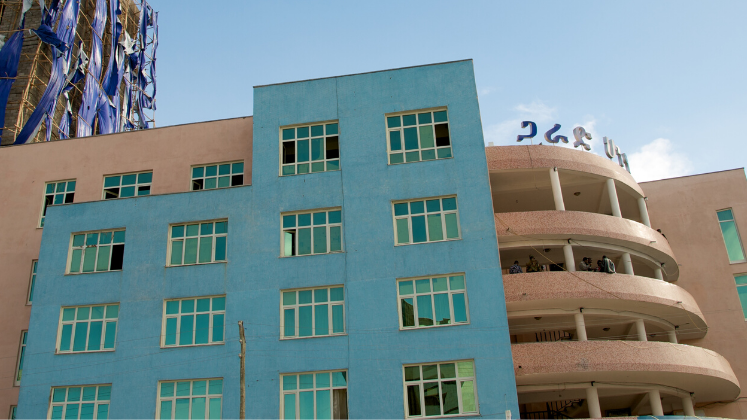
Prototype Credit: 'Modernism in Makele' past Overseas Evolution Institute licensed under CC Past-NC 2.0
The book opens at the close of the nineteenth century with the author offering a broad, detailed survey into the twentieth century while reflecting on the difficulties of uncovering these cultural histories, suggesting on page 68:
The lack of adequate material about mid-twentieth century artists such as Emaelaf and Agegenhu make it challenging to research their work thoroughly. The artworks that are bachelor are few in number, since most are in individual collections, exterior the country or lost.
The author has fewer problems in documenting the wave of modernist ideas into the 1960s and the artists that followed through the Fine art School, as Giorgis is able to draw on a broad-ranging grouping of thinkers from within Federal democratic republic of ethiopia and across Africa to articulate the immense potentials, experiments and cultural outputs being fabricated. Giorgis dedicates a substantial function of the volume to focus on the 1974 revolution, the abolition of the monarchy and the impositions of the armed services junta, called the Derg, which unleashed the Cherry Terror on the land, ushering in a catamenia in which 'literary and artistic values were deemed worthless' (185). The onset of devastating famines led to artistic responses that, the author argues, generated 'some of the most amazing imagines in modernism'due south history'. The later sections of the book examine the contemporary era and the surge of artists including collectives such as The Dimension Group and the New Art Space Monastery that used art to grapple particularly with 'the state's fascination with "rapid evolution" […] that failed to conform the realities in which alterities transpired' (257).
The range of visual material incorporated into the book is of import, adding to Giorgis's inspiring writing style and giving the reader a real sense of the vast, various artistic output that captured Federal democratic republic of ethiopia and its experience of modernity beyond the long twentieth century. Highlights include Belachew Yimer'south Boxing of Adwa, celebrating the famous Ethiopian victory over the Italians at the end of the nineteenth century as the birth of the modern; Eyob KItaba'south Afalgugne (2017), capturing what Giorgis describes (277) equally 'the electric current massive disruption of urban space' acquired by the shock of capitalist urbanisation in recent decades; and Gebre Kristos Desta'southward (1979) haunting In the Third World, which Giorgis argues (134) 'conveyed the intricate dialectics of trauma and the aftermaths of genocide'.
Overall, the book presents a vital and under-documented history of the feel of modernity and the creative movements surrounding modernism, coming from a unique place that will appeal to a broad-ranging readership and is likely to become an of import and treasured text.
Annotation: This review gives the views of the writer, and not the position of the LSE Review of Books blog, or of the London Schoolhouse of Economics and Political Science.

rodrigueztoldneire1990.blogspot.com
Source: https://blogs.lse.ac.uk/lsereviewofbooks/2020/07/03/book-review-modernist-art-in-ethiopia-by-elizabeth-w-giorgis/
0 Response to "Ohio Press Modernist Art in Ethiopia by Elizabeth W Giorgis"
Post a Comment